



MagicBlock is building a decentralized and unstoppable engine to enable any application to run entirely onchain. Our promise to builders is simple: they’ll never need a server again. They can build entirely on Solana and still get Web2-like performance for their onchain apps, without fragmenting liquidity.
We pioneered a new technology called Ephemeral Rollups (ERs), purpose-built for this. ERs are lightweight, ultra-fast SVM instances that can spin up just-in-time (JIT), operate on any subset of Solana state, are co-located with users, and remove any tradeoffs between onchain and offchain compute.
Today, we're revealing the economics behind $BLOCK, the native token that aligns incentives across node operators, developers, and users to scale the next generation of fully onchain experiences.
Network token vs company tokens
Tokens originated as a coordination mechanism and incentivization tool to bootstrap networks. The original playbook for crypto was elegant: subsidize early participation until real usage and network effects take over, and then taper incentive rewards as the network scales and becomes self-sustaining. The promise was a better way to create networks that couldn't exist before, with the people who built them owning a meaningful piece.
Somewhere along the way, that promise got corrupted.
Most tokens launched today aren't designed to bootstrap networks. They reuse words like “staking’ or “utility”, but their staking doesn't secure anything, and the token utility is dependent on a centralized team’s execution rather than on an autonomous protocol. This makes it functionally behave like equity without rights.
A useful mental model is the distinction between network tokens and company tokens. Network tokens derive their value from an onchain protocol that can operate openly and credibly without relying on any single company, like SOL, BTC, or ETH. Company tokens, by contrast, derive their value primarily from cash flows controlled by a centralized company.
MagicBlock is building a permissionless network. $BLOCK is designed to help the protocol scale, be performant and secure: it coordinates security and performance of node operators via a staking & slashing mechanism; it is mechanically tied to protocol activity through fees (including a protocol fee path that results in $BLOCK buybacks when users pay in SOL), and it funds programmatic ecosystem incentives that directly expand onchain usage.
How $BLOCK works
$BLOCK is a network token. It coordinates and incentivizes users, developers and node operators to ensure bootstrapping and long-term value-capture for the protocol.
Programmatic Incentives
Most token rewards are arbitrary. Projects pick an inflation rate, then figure out how to distribute it. We are doing it differently. In MagicBlock, when an application delegates more accounts to ER sessions, it drives more protocol usage, more fee volume, and more demand for real-time compute. That’s why we are introducing programmatic rewards structured around measurable onchain contributions. A reward contract tracks which addresses generate the most delegations over time and routes a share of emissions to those users or programs. It’s a simple idea, but it changes the game from the old playbook of arbitrary inflation that is detached from the protocol KPIs. The reward system can be dynamic (inflation increases when delegations are low, and decreases when delegations exceed a target) and proportional to the activity of each user and smart contract driving it.
Staking & Slashing
Node operators secure permissionless Ephemeral Rollup sessions. Node operators and users stake $BLOCK to participate in the security mechanism and earn staking rewards. If node operators don’t meet certain uptime and performance requirements, or deviate from the deterministic computation of the logic and commit an incorrect state update, they will get slashed. Stake ensures skin in the game and accountability.
Protocol Fees
All Ephemeral Rollups commits and undelegations to/from Solana capture a protocol fee. This can be paid in SOL, which accumulates into a vault. Eventually, the protocol will activate buybacks for $BLOCK. This creates consistent buy pressure tied directly to network usage. The more the network's economic value grows, the more value $BLOCK captures.
Token Distribution
Total Supply: 10,000,000,000 $BLOCK
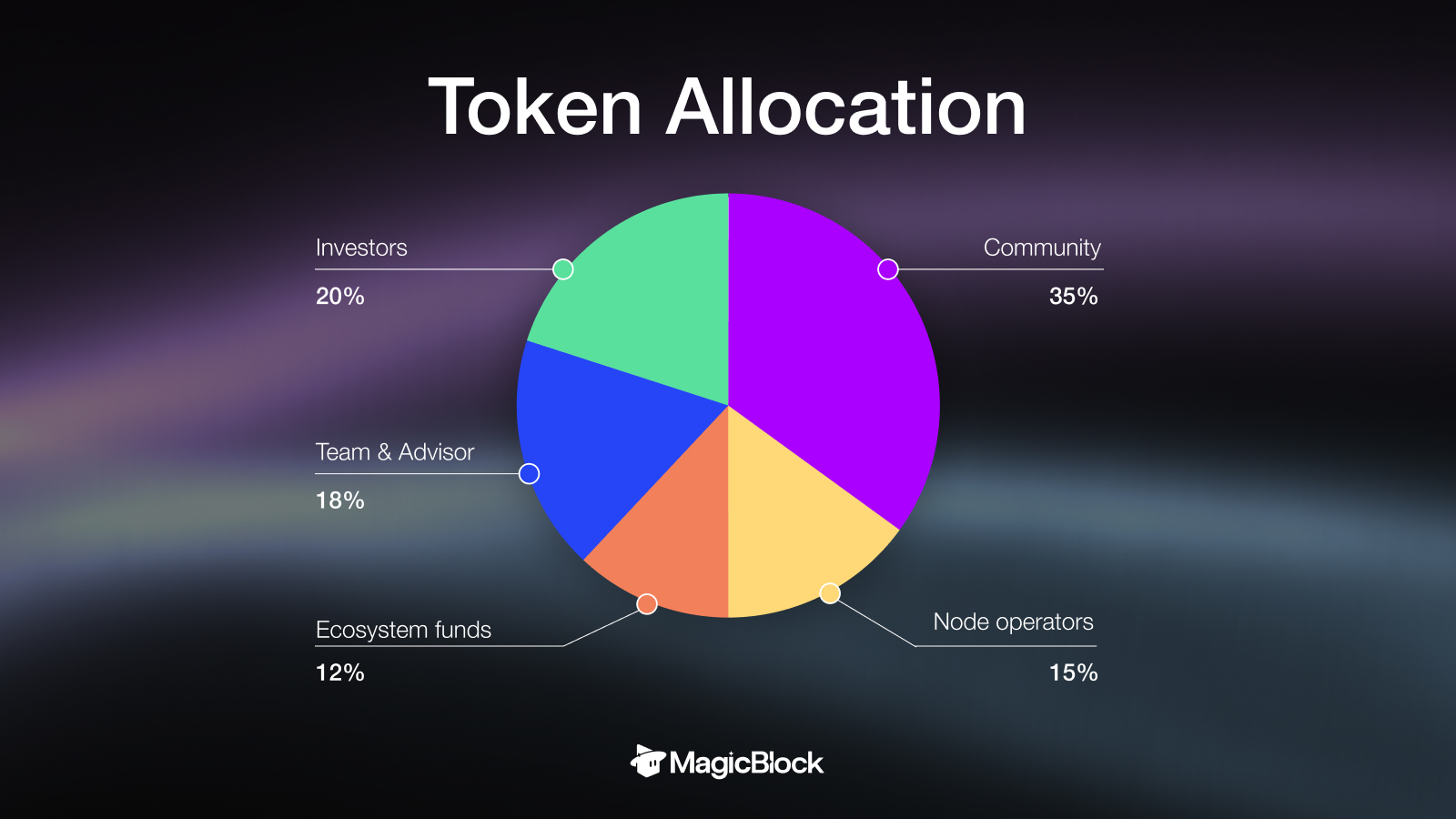
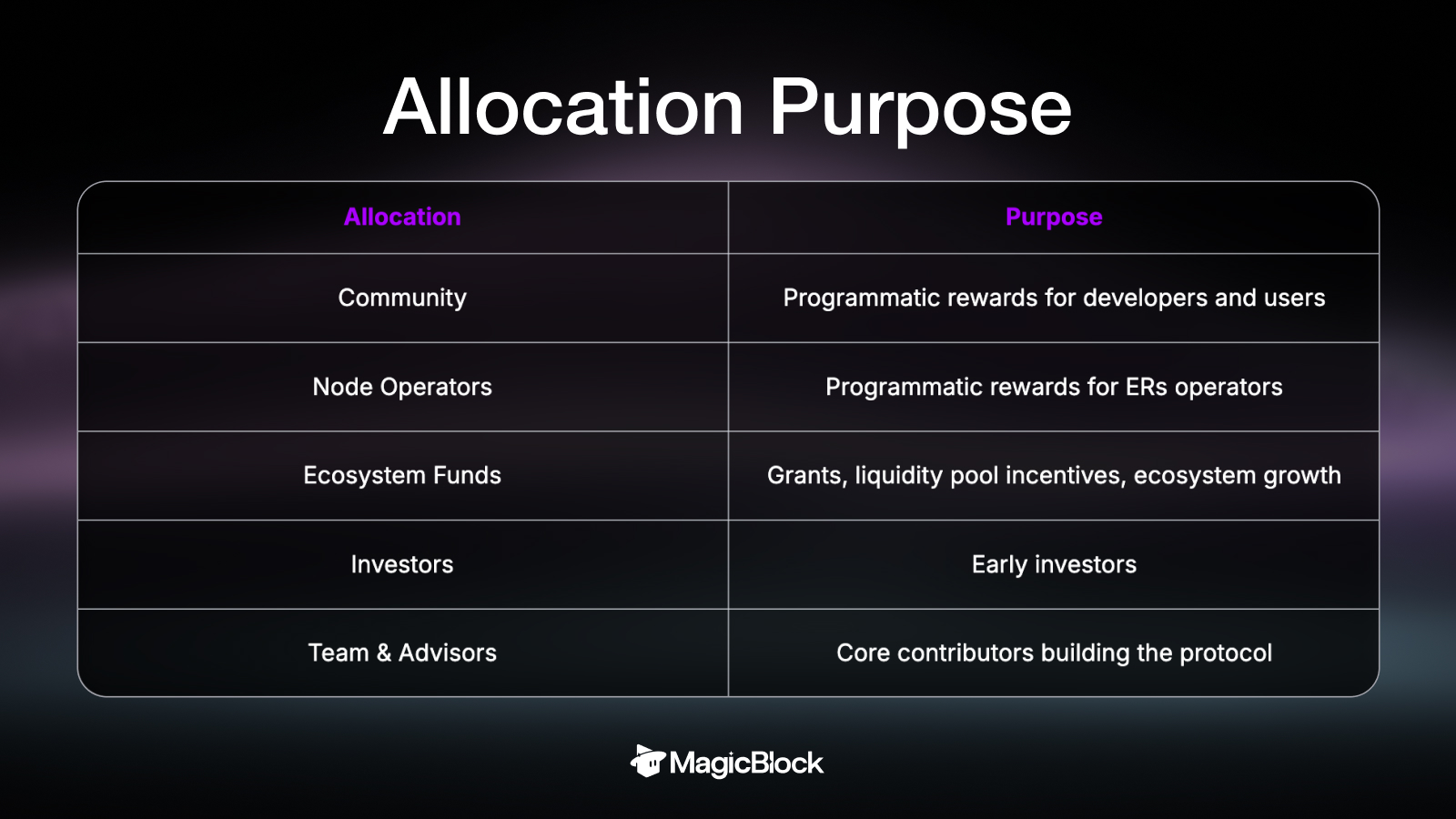
Community-first allocation. 50% of the supply goes directly to community (users & developers) and node operators, the people actually using and securing the network.
Vesting & Unlock Schedule
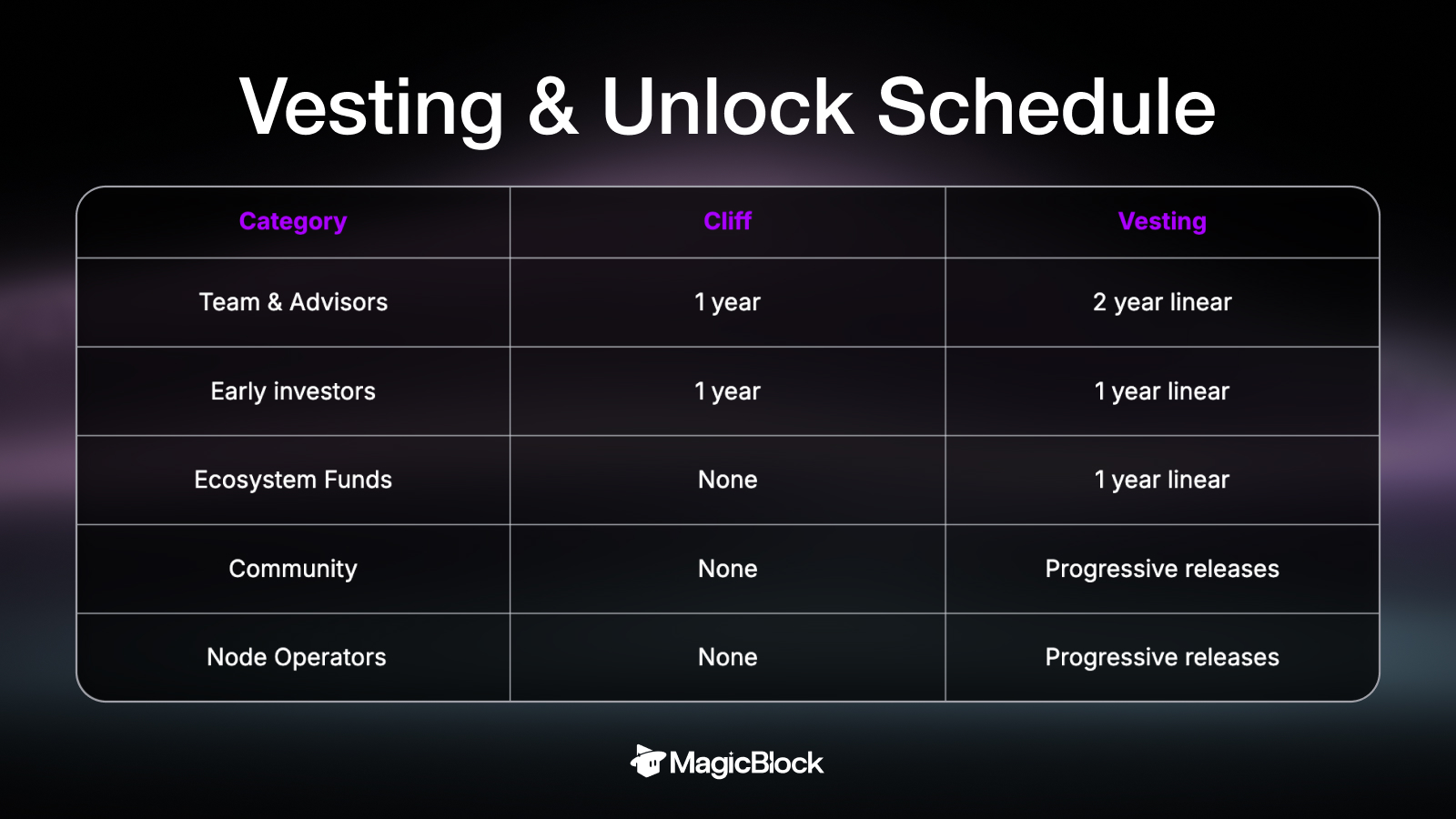
Team tokens are locked the longest. 3 years before the team tokens are fully unlocked. Community and node operator allocations unlock based on ecosystem growth milestones and programmatic incentives. Protocol incentives flow towards those that bring value with usage.
The Flywheel
Here's the flywheel through which $BLOCK creates sustainable value:
- Developers build → more applications go live on MagicBlock
- Users interact → more transactions flow through Ephemeral Rollups
- Protocol fees accrue → more value capture flows into $BLOCK
- Ecosystem grows → rewards distributed are more valuable, and more developers & node operators are attracted by activity and incentives
Every participant benefits when the network grows.
What We've Built
Two years ago, we started building an ambitious product with a simple thesis: any application should be able to run fully onchain. Since launching MagicNet in June of 2025, we've processed over 1 billion transactions, with 250K delegations and 27K unique addresses across 18 live apps. We are excited for the next phase of growth and the take-off of protocol-driven incentives with the launch of $BLOCK.
Join the Presale
The $BLOCK presale will soon open to early supporters who want to be part of the future of the next-generation of onchain applications.
If you believe in a fully onchain future, this is where it starts.
Disclaimer: This blog post is for informational purposes only and does not constitute financial advice. Token sales may be subject to regulatory restrictions in certain jurisdictions. Please conduct your own research and consult with legal and financial advisors before participating in any token sale.


